
How to talk about your time supporting teams

Your experience as a purpose-driven professional managing, supervising, and supporting high-performing teams is very transferable to project management, people management, and operations... but you wouldn't believe how many times I run into people who don't see it that way. So today, let's build the case!
First things first... you know by now that I'm going to open by encouraging you to map your efforts to the value they create.
...Which makes this a really good opportunity to clarify that this does not mean that the work you do supporting teams does not have inherent value. It does! On some level, we should be doing the work to motivate and support high-performing teams because everyone who works with us deserves to feel valued and supported as employees and human beings. Building a world where everyone feels this way is probably part of the reason you got into this work in the first place, and (if you ask us) the reason you're here always matters.
That said, it's also helpful to articulate this value directly and explicitly to hiring managers, and take it from "inherent" to "explicit" in case they don't intuitively see it.
In short: you are selling yourself short if you stop at describing development for development's sake. So let's talk about what to do instead.
Defining Value
When I say "defining value", I don't always mean that we need to land on a specific number, or that the value needs to be financial.
In fact, we can think of "value" as any benefit that a team, person, or org produces, as perceived by a given stakeholder. And in general, we want to see that any given initiative returns a value we can measure as greater than zero.
For example, economic value added is a valuation quant metric that basically says that projects should return financial value above what we spent to achieve them, and PMI has moved to use this idea to underlie their definitions of projects and project success.
But economic value added is not always straightforward, and not all rates of return can be measured financially. As another example, no one would argue against providing professional development for employees we manage (or who rotate in and out of our project teams). We've all benefited from professional development. We know when greenlighting professional development for others, based on our own lived experience, that our teams will benefit from this professional development. Yet most of us would be at a complete loss to quantify, in dollars, the return on investment.
Most of us still greenlight the professional development, because there are some things we know, even if we can't quantify them: it makes financial sense to provide benefits that make employees happy and increase retention, because attrition is expensive. It makes financial sense to provide benefits that increase skills, because efficient employees complete projects quickly and with higher accuracy. We can't quantify these, but we know they matter.
Notice what we're doing and what we're not doing here, when we're building our case for professional development:
- What we're not doing: claiming to be able to calculate a specific rate of return. "This workshop will cost my team $200. After completing it, they'll be able to give me $200 more dollars than before. How could I resist a 100% return on investment!!!!!!" Sounds ridiculous, right? It is. So we're not going to claim that.
- What we are doing: citing very specific behaviors that solve very specific problems. "This workshop will strengthen my employees' skillset, leading to faster project completion times – which, in time, I might be able to measure, once I've got more data. In the meantime it will also lead to increased job satisfaction, which decreases turnover and in turn decreases expenses associated with frequent hiring, onboarding, and training."
So, while we can't always answer the question "how much", it's very often enough to answer the question of "how".
Operationalizing Teamwork
Now that we've talked a little about defining value, let's operationalize teamwork - that might be all you need by itself! The 7th edition of the PMBOK defined five core processes that make teams "work":
- Vision & Objectives
- Roles & Responsibilities
- Operations
- Guidance
- Growth
As of 2026, the 8th edition moves one step further to give us a handy inputs -> tools & techniques -> outputs chart... and, importantly, all three columns end with that famous single word signaling there's a lot of stuff going on here, use your best judgment from this non-inclusive list:
"Etc."
So, again, what's a manager to do while operationalizing the value they provided while supporting (or leading) teams?
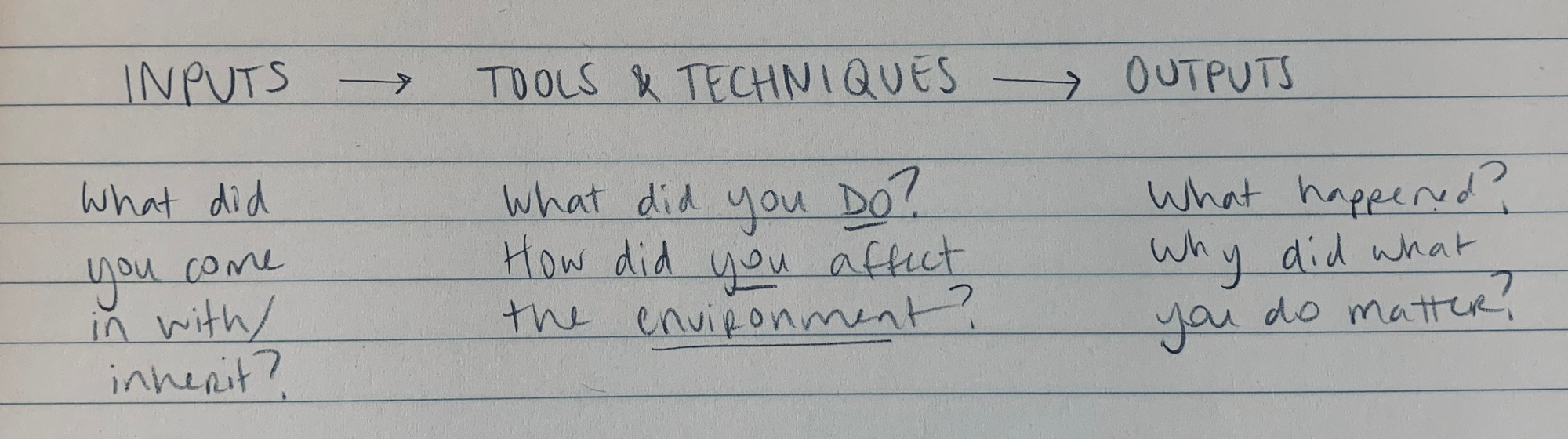
You can see that we're basically moving across the "what/so what/now what" framework here as we move from "what" to "how" to "why".
If you've gotten stuck with articulating transferable skills before now, it's likely that you've gotten bogged down in the "what" and the "how". It's helpful to spend a LOT of time thinking through the "why" before we start to think about the what and the how:
-> How did the team performance change after your leadership? Why did that matter?
-> Were there any changes to team process made as the result of your leadership? Why did that matter?
-> Were there any big wins tied directly to your team leadership? Why did they matter?
Once you can answer the "why did that matter" questions, then and only then can you proceed to sketching out in detail how you did it. Skipping the "why" (the part they care about) to move to the "how" (the part we often care about – it's fun! look what I did!) is one of the areas we can run into a fundamental mismatch between what you care about and what your audience cares about.
Zooming Back Out
As we said earlier, we can usually identify that something matters, even if we can't quantify it, and the more specific we can be about the why, the less it matters that we can't come with concrete numbers. No matter who you are, it's important to deeply understand these specifics:
Project managers need a deep understanding because there's an additional layer that you will be managing project teams made up of folks you may or may not supervise – which makes some of these areas murky. Ultimately, you are accountable to the project itself, to the project's sponsor, and to the project's stakeholders, which means that it is both 1) to your advantage and 2) your responsibility to make sure that those five processes are humming smoothly along – even when the folks on your team are not your direct reports.
People managers need to understand this because your peoples' success is ultimately your success – you're directly accountable for how they grow and perform under you.
As you can probably imagine, all areas of team management can start to melt down a little in the hands of a manager without great interpersonal skills. For example - what if not everyone agrees at the project's outset how to prioritize objectives... and then resources contract and some tough decisions have to be made? What if a team member starts performing poorly and needs some real guidance, but they don't want to hear it and definitely not from you you're not my boss anyway why do we even have a project manager your whole job is just sending emails isn't it? (Am I speaking from experience? Maybe. Let's leave it at: sometimes you need a tough skin to be a project manager.)
What this means for you: you have interpersonal skills out the wazoo. You may have an advanced degree that supports them. You definitely have a career history that supports them. So let's zoom back out for a moment and start thinking: based on everything you know about teamwork, how might you start answering the question of "how"?
Sometimes, it's helpful to start in the negative. What happens if we don't have someone overseeing vision/objectives, roles/responsibilities, operations, guidance, and growth?
People start fighting over how to prioritize project outcomes -- especially when resources are tight. People step on each others' toes, not knowing whose job is what. People have no idea how to do their jobs, even if they can agree on what they're supposed to be doing, and they definitely don't know how to get better at them. Hot mess express.
And then we can contrast: what happens when we hop off the hot mess express? Specifically, behaviorally?
- Team members are more likely to 1) spot an an issue and 2) speak up to avert it before it becomes a crisis when we've provided growth opportunities to facilitate their ability and fostered a culture of collaboration.
- Team members are more likely to have learned something in outside professional development that they can bring back to the team for increased effectiveness or productivity. Sometimes this can even result in new products or services being offered.
In both of the above examples, it's hard-to-impossible (especially early on) to calculate a return on investment... but it's very possible to articulate them. And often, that is enough when it comes to defining value for soft skills!
Your mission
Your teams mission moving forward, then – though you can apply this to any soft skills you're highlighting – is two-fold. First, comb your background for all things team. What's your highlight reel? When you think back to the great teams you've led, what specific processes led you there? Next, operationalize, operationalize, operationalize. When you're describing this highlight reel:
- What specific behaviors did the team display? How did they talk to each other? How did they interact? How were they trained?
- What would have resulted if they did not do those things?
- What resulted because they did do those things?
If you can be truly specific about answering those three questions... congratulations! You did it! You defined value! :)
Member discussion